


What $1,000 a Month in Rent Gets You Across Southeast Asia in 2026

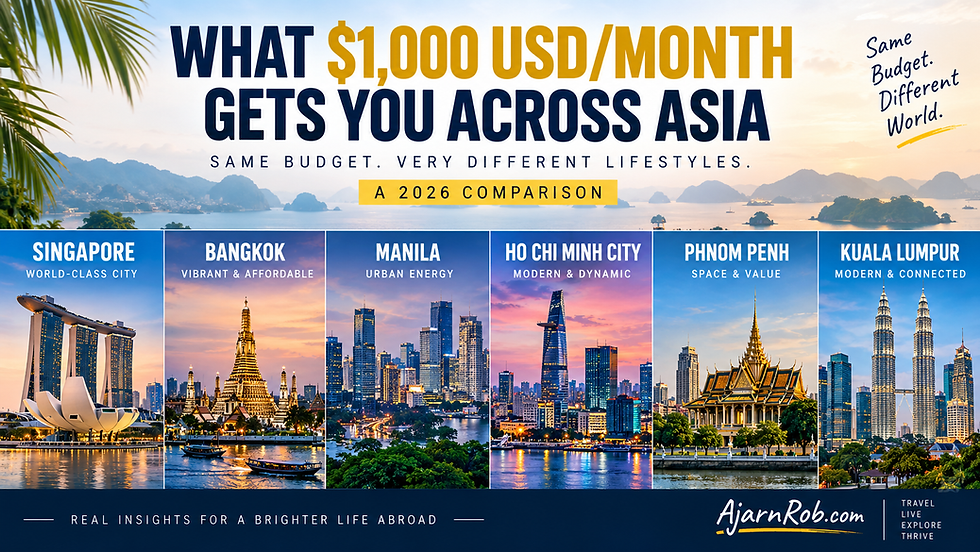
One of the biggest attractions of moving to Southeast Asia is the possibility of getting considerably more for your housing budget than you might in the United States, Canada, Australia, or Western Europe.
But saying “Southeast Asia is cheap” doesn't tell you very much.
Southeast Asia contains one of the most expensive cities in the world alongside cities where $1,000 a month can still rent a large, modern apartment with a pool, gym, security, and other amenities.
So I thought it would be interesting to ask a simple question:
If you had exactly $1,000 USD per month to spend on rent, what could you realistically expect in different Southeast Asian cities in 2026?
I looked at six cities that frequently come up in conversations about expatriation and living in Southeast Asia:
Singapore, Bangkok, Manila, Ho Chi Minh City, Phnom Penh, and Kuala Lumpur.
This isn’t meant to be a scientific housing index. Apartment rents can vary enormously within the same city depending on neighborhood, building age, furnishing, amenities, lease length, proximity to public transportation, and how you find the property.
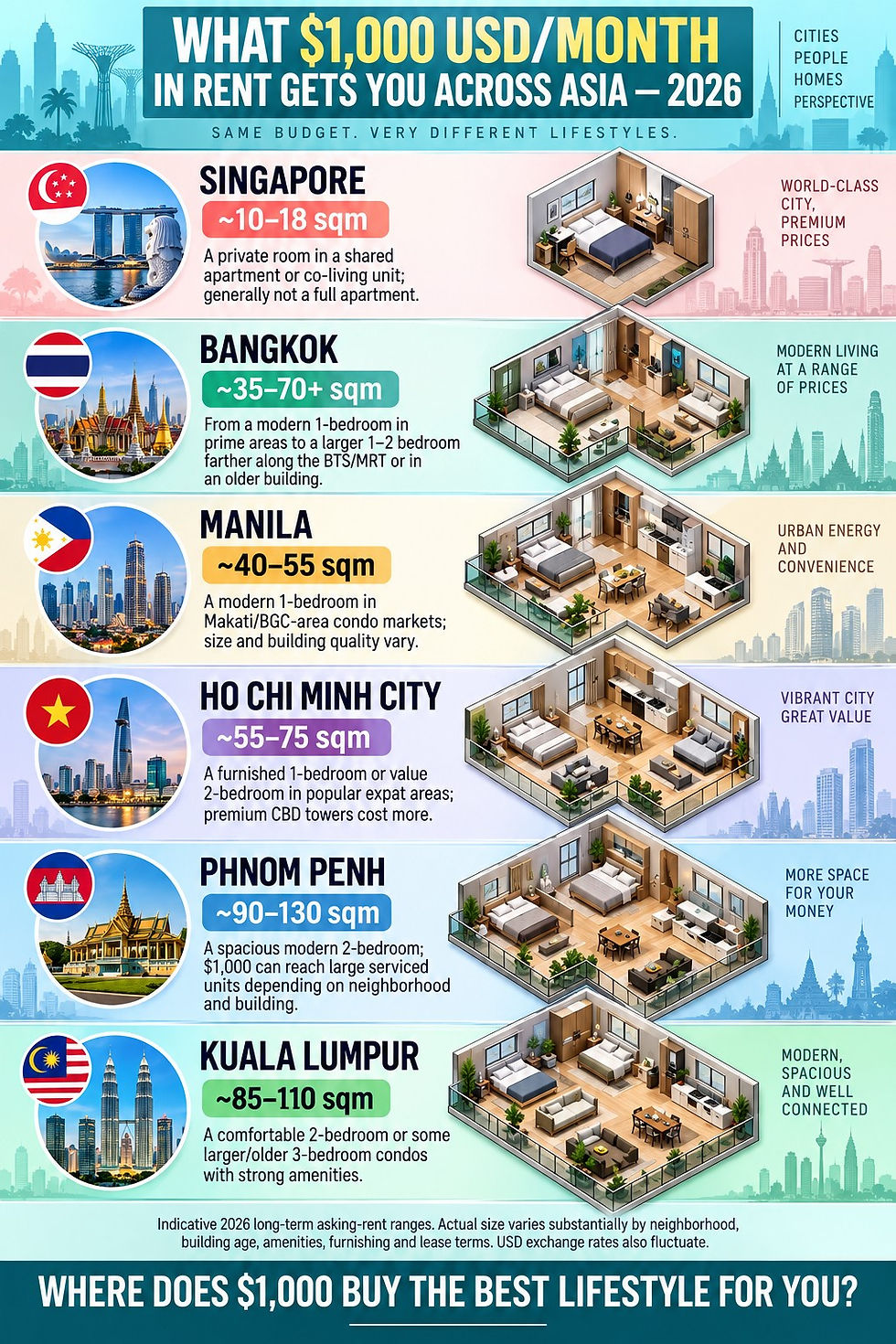
The square-meter ranges in the accompanying graphic should therefore be viewed as illustrative rather than guarantees.
But the broader comparison is revealing.
A $1,000 housing budget creates six very different lifestyles.
Singapore: $1,000 May Not Even Get You Your Own Apartment
Let’s start at the expensive end.
If your monthly housing budget is around $1,000 USD, Singapore is in an entirely different category from the other cities on this list.
Current 2026 rental data puts the average one-bedroom apartment in central Singapore at roughly S$3,700 (about $2,880 USD) per month, while even a one-bedroom outside the center averages around S$2,600 (about $2,020 USD).
In other words, $1,000 USD isn’t realistically a normal private-apartment budget in Singapore.
It’s much closer to a room-rental budget.
Current listings reinforce that point. Common rooms can be found around S$1,100–S$1,400 (about $855–$1,090 USD), with prices increasing for master bedrooms and more desirable central locations.
So I wouldn’t take the 10–18 square meter figure in the graphic too literally.
At this budget, the more important distinction is:
You’re probably renting a bedroom rather than an apartment.
What Singapore gives you in return is obvious: exceptional infrastructure, public transportation, cleanliness, international connectivity, and one of Asia’s most developed urban environments.
But you pay for it.
For an expat prioritizing living space, $1,000 doesn’t go very far here.
Bangkok: $1,000 Gives You Plenty of Choices
Bangkok is where the equation changes dramatically.
A $1,000 monthly housing budget translates to roughly ฿31,000–฿32,000 ($1,000 USD), depending on the exchange rate.
And that’s a healthy Bangkok rental budget.
Current rental data puts the average one-bedroom in central Bangkok at about ฿21,900 (about $695 USD), with a broad reported range of approximately ฿15,000–฿35,000 (about $475–$1,110 USD).
Outside the center, the average falls to around ฿10,600 (about $335 USD).
That means $1,000 gives you choices.
You could spend most of the budget on a newer condo in a more desirable central neighborhood.
Or you could move farther along the BTS or MRT lines and get considerably more space for less money.
You could also choose an older building.
That’s an overlooked strategy in Bangkok. New luxury towers may have beautiful lobbies, rooftop pools, and impressive gyms, but older Bangkok condominiums often offer significantly larger floor plans.
The 35–70+ square meter range in the graphic is therefore plausible as a broad illustration, but neighborhood and building age matter enormously.
฿30,000 (about $950 USD) around Phrom Phong or Thonglor doesn’t buy the same apartment that it does around On Nut or farther down the BTS line.
And that leads to one of my recurring pieces of advice about Bangkok:
The neighborhood matters more than the city.
Saving ฿5,000 (about $160 USD) on rent isn’t necessarily a bargain if you’ve added an hour of commuting to your day.
Manila: More Space, but Location Changes Everything
Manila is an interesting comparison because its rental market varies dramatically depending on exactly what you mean by “Manila.”
Metro Manila is enormous.
Makati, Bonifacio Global City, Ortigas, Quezon City, and other parts of the metropolitan area can produce very different rental experiences.
Current data puts a one-bedroom apartment in central Manila at roughly ₱34,000 (about $590 USD) per month, with reported prices ranging from approximately ₱25,000–₱50,000 (about $435–$870 USD).
Outside the center, the average drops to around ₱18,500 (about $320 USD).
So a $1,000 housing budget gives you considerably more flexibility than it does in Singapore.
The graphic estimates roughly 40–55 square meters, which is a reasonable way to visualize a modern one-bedroom in parts of the higher-demand condo market, although actual units can fall well outside that range.
In premium developments in Makati or BGC, you’re paying partly for location, security, amenities, walkability, and access to restaurants and offices.
Move away from those areas and your money stretches considerably farther.
Manila also illustrates why comparing countries purely by square footage can be misleading.
The neighborhood, traffic, building management, transportation, backup power, security, and surrounding infrastructure can matter just as much as whether your apartment is 45 or 60 square meters.
Ho Chi Minh City: A Strong Balance Between Space and Urban Lifestyle
Ho Chi Minh City is where $1,000 starts buying a genuinely comfortable urban apartment.
Current 2026 rental data puts the average one-bedroom in the city center at roughly ₫15 million (about $570 USD) per month, with a reported range of approximately ₫12–25 million (about $455–$950 USD).
Outside the center, the average drops to roughly ₫7 million (about $265 USD).
That leaves substantial room within a $1,000 budget.
In many parts of the city, you can realistically look for a well-furnished one-bedroom, a larger serviced apartment, or potentially a two-bedroom depending on neighborhood and building.
The graphic estimates roughly 55–75 square meters.
Again, don’t treat that as a universal market rate. Premium towers in central or highly desirable expat areas can command considerably more.
But the broader conclusion holds:
Ho Chi Minh City offers substantially more private living space for $1,000 than Singapore and generally more flexibility than the premium parts of Bangkok or Manila.
It also gives you a very different lifestyle.
Ho Chi Minh City is dense, energetic, noisy, entrepreneurial, and increasingly modern. New residential developments sit alongside older neighborhoods, street food, cafés, motorbikes, and an urban environment that can feel considerably more chaotic than Singapore or Kuala Lumpur.
For some expats, that’s exactly the attraction.
Phnom Penh: $1,000 Can Buy Serious Space
Phnom Penh is one of the clearest examples of how dramatically housing value can change as you move around Southeast Asia.
I lived in Phnom Penh myself, and housing was one of the areas where the difference compared with more expensive Asian cities was immediately obvious.
Current September 2026 data puts a one-bedroom in central Phnom Penh at around $630 USD per month, with a broad range of approximately $400–$1,190 USD.
A three-bedroom in the city center averages around $1,140 USD, while a three-bedroom outside the center averages around $800 USD.
Those numbers tell you a lot.
With $1,000 dedicated solely to housing, you’re no longer asking:
“Can I afford my own apartment?”
You’re asking:
“How much apartment do I actually want?”
A modern two-bedroom with significant living space can be realistic, and depending on location, building, and negotiation, larger units may also fall within the budget.
That’s why the graphic’s approximate 90–130 square meter range isn’t unreasonable as an illustration of the kind of space Phnom Penh can offer, although it shouldn’t be interpreted as a market guarantee.
The tradeoff is that Phnom Penh doesn’t offer the same infrastructure, mass transit, urban polish, or depth of services that you’ll find in Singapore, Bangkok, or Kuala Lumpur.
You get more housing for your money.
Whether that translates into a better overall lifestyle depends entirely on what you value.
Kuala Lumpur: A Lot of Apartment for the Money
Kuala Lumpur deserves more attention in conversations about expat living in Southeast Asia.
For pure housing value, it is extremely competitive.
Current September 2026 data puts a city-center one-bedroom at approximately RM2,570 (about $610 USD) per month, while a one-bedroom outside the center averages roughly RM1,560 (about $370 USD).
Actual listings demonstrate just how much variation exists.
Two-bedroom units can commonly appear around RM2,500–RM3,800 (about $595–$905 USD) in developments around Kuala Lumpur, including units roughly 750–1,000 square feet.
Even parts of the greater city-center market can offer two-bedroom units around RM2,600–RM3,200 (about $620–$760 USD), although premium KLCC developments can cost considerably more.
That’s roughly the point illustrated by the 85–110 square meter range in the graphic.
You can get a lot of apartment for the money.
And often you’re not talking about bare-bones accommodation.
Kuala Lumpur has an enormous supply of modern condominium developments offering pools, gyms, security, parking, and relatively large floor plans.
This combination of modern infrastructure and relatively inexpensive housing is one reason Kuala Lumpur deserves to be on the shortlist for anyone comparing long-term bases in Southeast Asia.
The $1,000 Question Isn’t Really About Square Meters
At first glance, this comparison looks like a contest over apartment size.
It isn’t.
The more useful question is:
What kind of life does $1,000 in housing buy you?
In Singapore, you’re paying a premium to live in one of the world’s most developed and globally connected cities.
In Bangkok, you’re getting an unusually strong combination of modern urban infrastructure, public transportation, healthcare, entertainment, and relatively affordable housing.
In Manila, location becomes especially important because the metropolitan area is so large and traffic can dramatically affect daily life.
In Ho Chi Minh City, you’re getting substantial housing value combined with one of Southeast Asia’s most energetic urban environments.
In Phnom Penh, your money can buy dramatically more physical space, but you’re accepting less-developed infrastructure.
And in Kuala Lumpur, you’re getting a strong combination of space, modern condominium living, infrastructure, and price.
That is why rent alone should never determine where you move.
What the Graphic Gets Right—and Where You Should Be Careful
The broad pattern shown in the graphic holds up reasonably well against current 2026 rental data.
Singapore is dramatically more expensive.
Bangkok and Manila occupy a middle ground where $1,000 provides a comfortable private-apartment budget, but location matters enormously.
Ho Chi Minh City stretches the money further.
Phnom Penh and Kuala Lumpur can offer substantially larger apartments for the same budget.
But I would not interpret the square-meter figures as precise averages.
Rental markets simply don’t work that neatly.
A new 40-square-meter luxury condo beside a major transit station can cost more than an older 80-square-meter apartment a few kilometers away.
A serviced apartment with housekeeping can cost more than a conventional annual lease.
A three-month or six-month lease can cost more per month than a one-year contract.
And apartments marketed specifically toward foreigners can sometimes carry different pricing from properties found through local networks.
The $1,000 figure also represents rent only.
It doesn’t include electricity, water, internet, deposits, agent fees where applicable, cleaning, parking, or other housing-related expenses.
Exchange rates matter too.
A $1,000 budget today may not translate into the same amount of baht, ringgit, pesos, dong, or Singapore dollars a year from now.
Don’t Spend $1,000 Just Because You Can
There’s another point prospective expats often overlook.
If your maximum housing budget is $1,000 per month, that doesn’t mean you should spend $1,000.
This is particularly true in cities like Bangkok, Phnom Penh, Ho Chi Minh City, and Kuala Lumpur.
If a $600 apartment gives you everything you actually need, the additional $400 might be more valuable elsewhere.
That’s $4,800 per year.
That money could pay for flights home, health insurance, travel around Asia, restaurants, hobbies, language lessons, or simply provide additional financial security.
One of the easiest ways to turn an affordable Asian lifestyle into an expensive one is to immediately start upgrading everything simply because it seems cheap compared with home.
A $1,500 luxury condo might feel like a bargain if the equivalent apartment would cost $4,000 in New York or Los Angeles.
But you’re not living in New York or Los Angeles anymore.
Your financial decisions should eventually reflect the economy and lifestyle where you actually live.
The Bigger Lesson: Geography Changes Your Lifestyle
This is one of the reasons geography matters so much when choosing where to live abroad.
The same income can produce radically different lifestyles depending on where you put yourself.
A person with a $3,000 monthly income living in Singapore faces a very different financial reality from someone earning the same amount while living in Phnom Penh.
The same applies within countries.
$1,000 in central Bangkok isn’t the same as $1,000 in suburban Bangkok.
And $1,000 in Bangkok isn’t the same as $1,000 in Chiang Mai, Hua Hin, or a smaller Thai city.
So when someone asks me:
“How much does it cost to live ib Southeast Asia?”
My answer is always going to be:
Where in Southeast Asia? And what kind of life do you want?
Those two questions matter far more than any generic cost-of-living number.
So Where Does $1,000 Go Furthest?
If we’re talking strictly about housing space, the broad pattern is clear.
Singapore gives you the least space for your money.
Bangkok and Manila give you a comfortable private-apartment budget.
Ho Chi Minh City gives you considerably more flexibility.
Phnom Penh and Kuala Lumpur can give you a surprisingly large amount of space.
But I wouldn’t choose where to live based on that ordering.
An apartment is only one part of your life.
Transportation, healthcare, visas, taxes, language, food, climate, pollution, social life, infrastructure, proximity to family, and whether you actually enjoy the culture matter too.
The cheapest city isn’t automatically the best value.
The better question is:
Which city gives you the lifestyle you want at a price you can comfortably sustain?
And that’s a much more useful way to think about moving abroad.
Research Note
The rental figures in this article are indicative 2026 asking-price and cost-of-living estimates, not guaranteed rental prices.
Housing markets vary substantially by neighborhood, building age, unit size, furnishing, amenities, lease length, season, and negotiation. Currency conversions are approximate and will fluctuate with exchange rates.
The square-meter ranges shown in the accompanying graphic are intended primarily to illustrate the relative purchasing power of a roughly $1,000 monthly rental budget. They should not be interpreted as citywide averages or promises that a particular size of apartment will always be available for that price.
Cost-of-living databases such as Numbeo provide useful citywide benchmarks, while current property listings can provide a better indication of what renters can actually find at a particular moment. For that reason, rental comparisons are best treated as ranges rather than exact figures.
For current listings, PropertyGuru Singapore and PropertyGuru Malaysia provide useful market examples for Singapore and Kuala Lumpur.



Comments