


10 Smaller Places to Live in Southeast Asia: Great Alternatives to the Big Cities

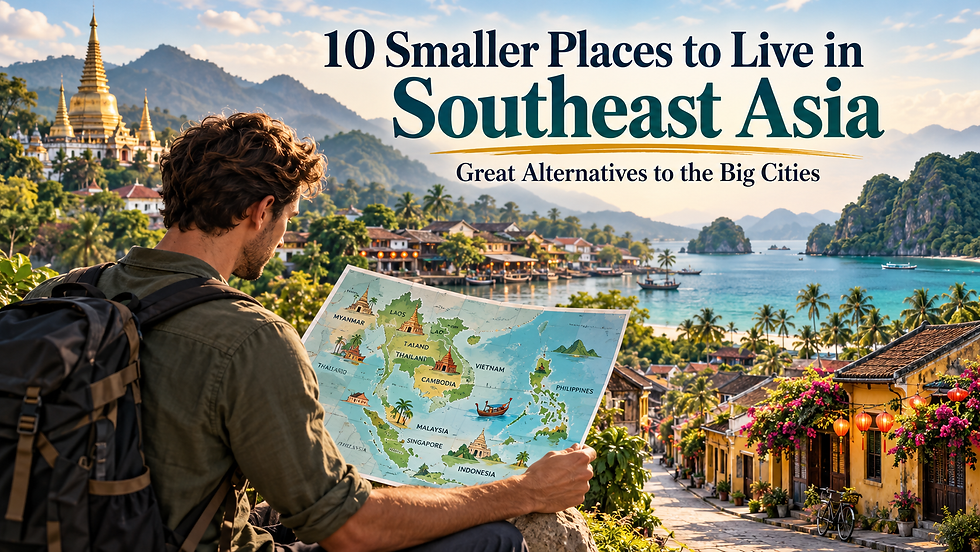
When people start researching a move to Southeast Asia, they tend to encounter the same handful of destinations.
Bangkok. Chiang Mai. Kuala Lumpur. Penang. Bali. Ho Chi Minh City. Manila.
There are good reasons for that. Larger cities generally offer the best hospitals, international airports, shopping, restaurants, transportation, and established foreign communities.
But those advantages come with tradeoffs.
Traffic. Crowds. Pollution. Higher rents. Longer commutes. More development. And sometimes the feeling that you've moved halfway around the world only to recreate another busy urban lifestyle.
For some people, smaller may actually be better.
And this isn't simply a list I've assembled by looking at places on a map. I've personally traveled extensively throughout Southeast Asia and have visited eight of the ten places included in this article. The only destination on this list I have not personally visited is Dumaguete in the Philippines.
So for most of these places, I can draw not only on current research but also on firsthand experience—what the place actually feels like, its scale, geography, atmosphere, transportation, tourism, and whether I could realistically imagine living there rather than simply visiting.
That distinction matters.
A town can look fantastic in photographs and still be difficult to live in. Conversely, some places that rarely appear on conventional “best places in Southeast Asia” lists can be surprisingly comfortable once you spend time there.
The challenge is finding somewhere that is small without being impractical.
A remote beach or mountain village might be wonderful for a two-week vacation but frustrating after six months if you need a hospital, decent supermarket, reliable internet, banking, transportation, or some kind of social community.
So for this list, I looked for places with populations of roughly 250,000 people or fewer that still offer enough infrastructure to make longer-term living realistic.
That population figure is deliberately approximate. Comparing population statistics across Southeast Asia is messy. One country reports municipality populations, another uses districts, another urban areas, and another metropolitan boundaries. A place can therefore appear much larger or smaller depending on which administrative unit is being measured.
The same problem exists when trying to count expatriates.
There is no standardized database telling us exactly how many Westerners or foreign residents live in each of these places. Where reasonably credible numbers exist, I've included them in the individual sections. Where they don't, I'll simply describe whether the foreign community appears large, small, or relatively visible rather than inventing a number.
And one final point: these aren't ranked from best to worst.
Pai and Amed offer completely different lifestyles from Hua Hin or Chiang Rai. Siem Reap is much more internationally oriented than Luang Prabang. Dumaguete may appeal strongly to retirees, while Hoi An could be more attractive to someone wanting a walkable town close to a larger city.
The objective isn't to identify one universally “best” small city in Southeast Asia.
It's to show that if Bangkok, Kuala Lumpur, Manila, or Ho Chi Minh City feel too large, crowded, or intense, you have far more options than you may realize.
Here are ten smaller places in Southeast Asia that I think deserve serious consideration.
Again, the population units aren't perfectly comparable. Think of them as a way to understand scale rather than a demographic ranking.
1. Kampot, Cambodia
Kampot may be one of the clearest examples of what I mean by a smaller Southeast Asian place that can still work for foreign residents.
It sits along the Preaek Tuek Chhu River in southern Cambodia, surrounded by countryside, pepper farms, mountains, and a relaxed riverfront lined with restaurants and cafés.
One of Kampot’s biggest advantages is location.
The coastal town of Kep is only about 26 kilometers away—roughly a 25-minute drive—so you can have riverside living in Kampot while still being within easy reach of the sea and beaches. Phnom Penh is also reasonably accessible: National Road 3 connects the capital directly with Kampot, a distance of about 135 kilometers, with private-car travel generally taking around three hours.
That combination gives Kampot an interesting balance. You can live somewhere genuinely small and relaxed without feeling completely cut off from either the coast or Cambodia’s capital.
Cambodia's 2019 census counted 58,956 urban residents in Kampot Province, which gives you a sense of just how small the urban environment remains.
Yet Kampot has developed enough international infrastructure that foreigners can find cafés, Western restaurants, rentals, guesthouses, bars, yoga, motorbike services, and businesses accustomed to foreign customers.
The foreign community is small but unusually visible, but there is no reliable current expat count.
Kampot’s foreign community also grew partly because of what happened farther west in Sihanoukville.
During the late 2010s, massive Chinese investment—particularly in casinos, hotels, apartments, and other development—rapidly transformed Sihanoukville. Contemporary reporting documented Western-oriented businesses losing customers and being displaced as the city's economy increasingly catered to Chinese investors, workers, and tourists. Some foreign residents who no longer liked what Sihanoukville had become relocated to quieter alternatives such as Kampot and Kep. The Guardian
I wouldn't characterize Kampot simply as a refuge from Sihanoukville—that would oversimplify why people live there—but that migration did contribute to the town's modern expat character.
What seems clearer today is the makeup of the community: long-term residents, retirees, small-business owners, foreign-Khmer families, NGO workers, and a modest remote-work crowd.
In a town this small, you don't need thousands of foreigners before the community becomes noticeable.
That can be an advantage if you want somewhere where relationships develop quickly and you can become part of a recognizable local community.
The tradeoff is healthcare. Routine needs can be handled locally, but for serious specialist care I'd want a plan for Phnom Penh or Bangkok.
Overall, Kampot makes the most sense for someone who values affordability, river life, access to nature and the coast, community, and a slower pace more than big-city infrastructure.
2. Siem Reap, Cambodia
Siem Reap sits right at the upper edge of our population guideline.
Cambodia's 2019 census put Krong Siem Reap at about 245,000 people. The exact figure depends on the administrative boundary being used, which illustrates the population problem I mentioned earlier.
What makes Siem Reap unusual is that its tourism economy has created infrastructure far beyond what you would normally expect from a city this size.
Angkor Wat obviously dominates its international identity, but living there also means access to supermarkets, gyms, cafés, restaurants, international schools and services, modern rental housing, and regional air connections.
It also has one of the larger foreign communities on this list.
There is no definitive government expat census, but current estimates generally suggest several thousand foreign residents. One recent Expat.com guide estimates approximately 5,000–7,000 expatriates. I wouldn't treat that as an official statistic, but there is clearly a large enough international community to support an active social scene. Expat.com
I can speak from considerable personal experience here. I've spent a lot of time in Siem Reap and know the expat community reasonably well. If you want a social lifestyle, you can certainly have one. There are plenty of restaurants, bars, cafés, events, and gathering places where long-term foreign residents regularly cross paths.
And you don't have to spend your evenings on Pub Street.
Just across the Siem Reap River, the Wat Damnak area offers a quieter, more residential atmosphere while remaining only a short walk from the Old Market and Pub Street. There are restaurants, cafés, boutique hotels, and bars tucked into the streets around Wat Damnak, and it has long been one of my preferred areas of the city. Wat Bo and Sala Kamreuk are also popular with foreign residents who want to stay close to the center without living directly in the tourist nightlife zone.
That's one of the things I like about Siem Reap. You can have nightlife and a very active social life when you want it, but you can also live five or ten minutes away and barely notice Pub Street.
It's also extremely affordable by Western standards. Current relocation estimates put a comfortable single-person lifestyle around roughly $700–$1,000 USD per month, although obviously you can spend considerably more depending on housing, dining, nightlife, and travel. One-bedroom apartments outside the center can still be found in roughly the $200–$300 range, according to current expat housing guides.
Personally, if I were ever looking for an alternative to Bangkok as my base in Southeast Asia, Siem Reap would be very high on my list.
Part of that is affordability and lifestyle. Part of it is the international community. But accessibility matters too.
Siem Reap now has the modern Siem Reap–Angkor International Airport, which opened in 2023 and was designed to handle substantially larger aircraft and growing international traffic. The new airport can accommodate long-haul aircraft and was initially designed for about seven million passengers annually, with plans for considerably greater capacity in the future.
However, there is one catch that comes up constantly when people discuss the new airport:
It's a long way from town.
The airport sits about 50 kilometers from Siem Reap city, replacing the old airport that was conveniently located just outside town. That distance has been a common complaint among residents and frequent visitors because an airport trip is now a real transfer rather than a quick tuk-tuk ride.
I understand the complaint. The old airport was incredibly convenient.
But in the bigger picture, I'd still rather live in a smaller Southeast Asian city that has a modern international airport 50 kilometers away than in one where reaching international flights requires half a day of overland travel.
Cambodia's visa system is another attraction. As of 2026, Cambodia's official eVisa system offers both Tourist Visa T and Ordinary Visa E initial entries, each allowing a one-month stay; the Ordinary E visa is the category relevant to many foreigners who later pursue an appropriate longer-term extension.
Tourism is also Siem Reap's biggest drawback. You're living alongside one of the world's most important archaeological destinations, and certain parts of town can feel extremely tourist-oriented.
But tourism is precisely what supports much of the city's restaurant scene, English-language services, nightlife, air connectivity, and international infrastructure.
And once you get away from the central tourist corridor, Siem Reap can feel surprisingly relaxed.
For someone who wants a smaller Southeast Asian city that is affordable, social, internationally connected, and developed enough to make everyday life relatively easy, Siem Reap is one of the strongest options on this list.
3. Khao Lak, Thailand
Khao Lak is the place on this list I can speak about most personally because I currently spend a significant amount of time living here.
And the longer I've stayed, the more I think it deserves attention as a serious alternative to Thailand's better-known expat destinations.
Khao Lak isn't really one city. It's a series of small coastal communities stretching along the Andaman Sea in Phang Nga Province, including Nang Thong, Bang Niang, Khuk Khak, and the areas farther north toward Pakarang and Bang Sak.
That geography is actually part of the appeal.
Instead of one dense urban center, you have beaches, small commercial areas, resorts, restaurants, local neighborhoods, coconut groves, and long stretches of relatively undeveloped coastline.
Compared with Phuket, the difference is dramatic.
You still get the Andaman Sea, tropical beaches, diving, national parks, restaurants, supermarkets, and a tourism infrastructure accustomed to foreign visitors—but without anything approaching Phuket's density, traffic, or level of development.
For me, that is Khao Lak's biggest attraction.
It feels like a beach community rather than a beach city.
The foreign population is difficult to quantify because Khao Lak isn't a single municipality and a large portion of its international population is seasonal. There are long-term foreign residents and retirees, particularly Europeans, along with dive professionals, hospitality workers, business owners, and people who return for several months every year.
German and Scandinavian visitors have had a particularly strong presence in Khao Lak for years, and some eventually became seasonal or permanent residents.
It certainly doesn't have an expat community on the scale of Hua Hin, Pattaya, or Chiang Mai.
But there are enough long-term foreigners here that you don't feel completely isolated.
Khao Lak also has a lifestyle advantage that is easy to underestimate until you live here: nature is part of everyday life rather than something you have to travel to reach.
Beaches run for kilometers. Khao Lak-Lam Ru National Park sits immediately south of the main tourism area. The wetlands, mangroves, waterfalls, and forests of Phang Nga are nearby, while the Similan and Surin islands make this one of Thailand's major diving regions. Additionally, Khao Sok National Park is only about 70–90 minutes away.
And during the Andaman surf season, Khao Lak also has a small but growing surf culture—particularly around Memories Beach and the Pakarang area.
You can have breakfast, go surfing or walk along an almost empty beach, and still be at a supermarket or restaurant fifteen minutes later.
That combination is difficult to find in Thailand's larger resort destinations.
Another major advantage is that Khao Lak isn't an island.
You're connected directly to the mainland road network, and Phuket International Airport is roughly 70–90 minutes away depending on where in Khao Lak you live and traffic conditions.
That matters more than it might seem.
You get much of the lifestyle appeal of an island or beach resort without having to rely on ferries or domestic flights every time you want to travel.
Phuket also acts as Khao Lak's big-city backup.
If I need major shopping, specialized services, an international flight, or more sophisticated private healthcare, Phuket is close enough to reach by road.
That brings us to Khao Lak's main weakness.
Healthcare is adequate for ordinary needs, but this is not where I would want to depend entirely on local facilities for a serious or complicated medical condition.
There are clinics and hospitals in the surrounding Phang Nga area, but for more advanced private healthcare, Phuket is the more realistic option.
Transportation is another consideration.
Khao Lak is spread out.
If you live around Bang Niang or Nang Thong, you can walk to quite a few restaurants and services. But once you move farther north toward Khuk Khak, Pakarang, or Bang Sak, having a motorbike or car becomes considerably more useful.
There is no BTS, no extensive city bus system, and no dense urban grid.
That is part of the tradeoff for having all that space.
Seasonality matters too.
Khao Lak becomes considerably busier during the dry-season tourism period, while parts of the area become very quiet during the southwest monsoon.
Personally, I enjoy that rhythm.
But someone looking for a constant nightlife scene, huge restaurant selection, or year-round social calendar might find Khao Lak too quiet.
For me, that's largely the point.
I've lived in Bangkok for years, and I still enjoy having Bangkok as my main urban base. But Khao Lak offers something completely different: space, ocean, nature, less traffic, and a much slower daily rhythm without feeling completely cut off from civilization.
That's why I think it belongs on this list.
It isn't a hidden Thai fishing village anymore, but it also hasn't become another Phuket.
At least not yet.
Khao Lak makes the most sense for someone who wants quiet coastal living, beaches and nature on their doorstep, a modest international community, and access to Phuket when they need big-city infrastructure—without actually having to live in Phuket.
4. Hoi An, Vietnam
Hoi An is one of those places where people visit and immediately start imagining themselves living there.
It’s easy to understand why.
The historic center is compact and walkable, the architecture is extraordinary, restaurants and cafés are everywhere, and once you move outside the Ancient Town you quickly reach rice fields, local neighborhoods, and the coast.
UNESCO describes Hoi An as an exceptionally well-preserved Southeast Asian trading port where Vietnamese, Chinese, Japanese, and European influences came together.
But if you actually live in Hoi An, you probably aren’t going to live inside the main tourist district.
Many long-term foreign residents gravitate toward areas like Cam Chau, Cam Thanh, and especially An Bang Beach, where you can live in a quieter residential setting and still be only a short ride from the Old Town.
That gives Hoi An a much broader lifestyle than the tourist center suggests.
You can live near the rice fields, closer to the beach, or in a quieter neighborhood and simply visit the Ancient Town when you want the restaurants, cafés, lanterns, markets, and nightlife.
The coastline is another major advantage.
An Bang and Cua Dai beaches are only a short ride from town, giving you swimming, beach restaurants, and some seasonal surfing. An Bang in particular has developed a recognizable beach and surf scene, which adds another dimension to living there.
But Hoi An’s greatest practical advantage may still be Da Nang.
Da Nang is roughly 30 kilometers up the road, which means you can live in a much smaller, more atmospheric town while still having access to a major city with an international airport, large hospitals, shopping malls, supermarkets, restaurants, and virtually every service you’re likely to need.
That’s a pretty compelling combination.
You get small-town living with big-city infrastructure nearby.
The foreign community is substantial for a place this size. There is no reliable official count of Western residents, but estimates generally put the expat population in the several-thousand range. More important than the exact number is that there is clearly enough of a long-term international community to support cafés, coworking spaces, social groups, international restaurants, and a recognizable expat scene.
Vietnam’s standard e-visa currently allows stays of up to 90 days, while longer-term business, work, investment, and family-based options are available for people who qualify. The main limitation for retirees is that Vietnam does not currently offer a simple dedicated retirement visa.
The bigger drawbacks are tourism and seasonal flooding.
Hoi An’s Ancient Town can become extremely crowded, particularly in the evenings and during peak periods, but living outside the historic center avoids much of that.
Hoi An’s real advantage is the combination: live near the beach or rice fields, stay outside the main tourist zone, enjoy a substantial international community, and still have all the infrastructure of Da Nang—including an international airport—just up the road.
5. Dumaguete City, Philippines
Dumaguete may be the least familiar name on this list for readers who haven't seriously researched the Philippines.
It deserves more attention.
The city had 134,103 residents in the 2020 census, making it large enough to support hospitals, universities, supermarkets, restaurants, shopping, and everyday services while remaining far smaller than Manila or Cebu City.
What makes Dumaguete particularly interesting is that it isn't primarily a tourist town. People certainly pass through on their way to Siquijor, Apo Island, and the surrounding dive areas, but Dumaguete functions first as a university and regional city.
That gives it a different feel from somewhere built almost entirely around tourism.
Silliman University is a major part of the city's identity, and English is widely spoken. For Western retirees in particular, that significantly lowers the adjustment barrier.
There is also a relatively large and established foreign-retiree community. Rather than concentrating only in downtown Dumaguete, many foreigners live in the surrounding areas—Valencia, Bacong, Dauin, and Sibulan are frequently mentioned by residents as alternatives for people who want more space or less traffic while still having easy access to the city. Local discussions also suggest that some expats mainly come into Dumaguete for shopping, restaurants, healthcare, and other services rather than living directly in the center.
That arrangement makes a lot of sense to me.
You could live somewhere quieter in the surrounding area while still having Dumaguete as your practical center.
The geography is another major advantage. Dauin just south of town is one of the Philippines' better-known diving areas, Apo Island is nearby, and Valencia gives you a greener, slightly cooler inland alternative. Dumaguete is also the main gateway to Siquijor, with fast ferries generally taking around 45–60 minutes.
Transportation beyond the region is fairly convenient as well. Dumaguete has its own airport with regular connections to Manila and Cebu, which makes it much easier to use as a long-term base than many similarly sized Philippine cities.
Affordable—but Not Necessarily Dirt Cheap
Dumaguete remains affordable by Western standards and generally costs considerably less than living in Manila or many of the Philippines' major resort destinations.
But I wouldn't oversell the “cheap Philippines” narrative.
Residents have increasingly complained about rising rents, particularly for newer apartments and housing marketed toward foreigners and newcomers. Recent local discussions mention one-bedroom units reaching ₱20,000–₱25,000 ($340–$425) per month in some cases, while less expensive options are becoming harder to find within the city itself.
So Dumaguete can still be very affordable, but the lifestyle you choose matters. Living more locally or outside the center can keep costs low; expecting a newer Western-style apartment, imported foods, air-conditioning all day, and other conveniences changes the calculation quickly.
The Main Drawback: It's Busier Than You Might Expect
Dumaguete's reputation as a relaxed provincial city can be slightly misleading.
The city itself can get busy.
Traffic, particularly around the center and during rush hour, is one of the complaints that comes up repeatedly among residents. Part of the appeal of living in Valencia, Dauin, Bacong, or Sibulan is precisely that you can escape some of that congestion while keeping Dumaguete close enough for everyday needs.
Healthcare is another consideration. Dumaguete has legitimate hospitals and medical services, but for highly specialized or complicated treatment, Cebu or Manila may still be preferable. Current expat-oriented assessments consistently identify advanced healthcare as one of the city's weaker points.
Still, I think Dumaguete fills an interesting niche on this list.
It's not really a resort town, not a massive city, and not an isolated retirement enclave. It's a functioning Filipino university city with a sizable foreign-retiree community, widespread English, affordable living, good access to diving and islands, and quieter residential options just outside town.
For someone who wants to actually live in the Philippines rather than feel like they're permanently staying in a tourist destination, Dumaguete may be one of the more practical smaller-city choices.
6. Luang Prabang, Laos
Few places on this list can compete with Luang Prabang for atmosphere.
The historic city sits between the Mekong and Nam Khan rivers, surrounded by mountains and filled with Buddhist temples, traditional Lao buildings, French colonial architecture, cafés, markets, and quiet tree-lined streets.
I’ve spent time in Luang Prabang myself, and what stands out is how naturally the place slows you down. It’s not somewhere built around shopping malls, traffic, or constant activity. Much of daily life revolves around walking or cycling around town, sitting in cafés, eating along the river, visiting markets, and simply enjoying the surroundings.
The café culture is especially strong for such a small city. You’ll find everything from simple Lao coffee shops to bakeries and stylish cafés tucked into old colonial buildings. Add in inexpensive local food, low everyday transportation costs, and reasonably priced housing outside the most tourist-oriented areas, and Luang Prabang can still be very affordable by Western standards.
The foreign community is relatively small but established. There are long-term residents connected to tourism, hospitality, NGOs, education, small businesses, and development work. It’s nowhere near the scale of places like Siem Reap or Chiang Mai, but there is enough of an international presence that you won’t necessarily feel isolated.
One thing that has made Luang Prabang more practical in recent years is improved transportation.
The Laos-China Railway now connects the city with Vang Vieng, Vientiane, and destinations farther north, while Luang Prabang International Airport provides regional air connections. That makes it much easier to use as a base than it was when overland travel in Laos was considerably slower.
There are also longer-term visa options for people who qualify through business, employment, or other appropriate categories. The standard tourist eVisa is still short-term, so this is not quite as simple a retirement destination as Thailand or the Philippines, but living there longer term is possible with the right immigration setup.
The biggest drawback is probably the same thing that attracts people in the first place:
Luang Prabang is very quiet.
This is not a major nightlife or party city. Evenings tend to wind down early, and the range of restaurants, bars, and entertainment is naturally limited by the size of the place.
For some people, that would become boring.
For others, that’s exactly the appeal.
Healthcare is another limitation. Routine care is available locally, but for anything serious or highly specialized, I would want a plan for Thailand or another larger regional medical center.
Still, Luang Prabang offers something that is becoming harder to find in Southeast Asia: a beautiful, culturally rich small city where life genuinely moves at a slower pace.
For someone who wants mountains, rivers, café culture, affordability, history, and one of the slowest lifestyles on this list—while still having an airport and increasingly useful rail connections—Luang Prabang is a very compelling option.
7. Taiping, Malaysia
Taiping is probably the sleeper choice on this list.
It lacks the international name recognition of Hoi An, Chiang Rai, or many of Southeast Asia's better-known expat destinations.
That's part of what makes it interesting.
Located in Perak, Taiping is an old tin-mining town known for colonial architecture, food, greenery, heavy rainfall, and the beautiful Taiping Lake Gardens.
Malaysia's 2020 census counted 241,517 people within the Taiping municipal area, putting it just below the population guideline for this list. It's large enough to provide the services you need for everyday life but still feels much more like a provincial town than a major city.
Taiping is sometimes called Malaysia's "Rain Town," and all that rainfall helps explain why the area is so green. The Lake Gardens are the centerpiece of town, with enormous rain trees, walking paths, ponds, and Bukit Larut—formerly Maxwell Hill—rising immediately behind the city.
For someone interested in an outdoor-oriented lifestyle, that's a real advantage. You have places to walk, jog, hike, and simply spend time outside without having to travel far from home.
The pace is also noticeably slower than Kuala Lumpur, George Town, or Johor Bahru.
Taiping isn't trying to be trendy.
It has old neighborhoods, traditional kopitiams, wet markets, hawker food, colonial-era buildings, and the kind of everyday Malaysian street life that can sometimes get lost in the country's larger and more international cities.
And food is a major part of the appeal. Perak has an excellent reputation for Malaysian Chinese and local cuisine, and eating out remains inexpensive enough that it can easily become part of your normal routine rather than an occasional luxury.
Housing and everyday expenses are also generally affordable, particularly compared with Kuala Lumpur or Penang. Someone willing to live more like a local rather than demanding a luxury condominium or imported products can maintain a comfortable lifestyle without an enormous budget.
Another major advantage is Malaysia itself.
English is widely understood, the road network is excellent, banking and infrastructure are well developed, and healthcare standards are generally high. Taiping has both public and private medical facilities, while larger medical centers are available in Ipoh and Penang.
You also aren't particularly isolated.
Ipoh is roughly an hour away, while Penang is reachable in around 90 minutes to two hours depending on traffic and where you're going. That gives you access to larger hospitals, international shopping, airports, and a much bigger urban environment whenever you need it.
The foreign community, however, is relatively small.
This isn't Penang, Kuala Lumpur, or even somewhere like Hua Hin where you'll immediately encounter a large established Western expat network.
There are foreign retirees and long-term residents, but Taiping remains overwhelmingly Malaysian in character.
For some people, that will be a drawback.
For others, it's exactly why Taiping deserves to be on this list.
The main complication is long-term residency. Malaysia does have the Malaysia My Second Home (MM2H) program, but the current financial requirements are substantial, particularly compared with some neighboring countries. So while Taiping itself can be inexpensive and easy to live in, qualifying for a long-term stay may require considerably more financial planning.
There's also the question of whether Taiping might simply be too quiet.
This isn't a major nightlife destination, there isn't a huge international social scene, and anyone who needs constant entertainment or a large expat community may eventually find it limiting.
But if that's not what you're looking for, the equation changes.
Taiping makes sense for someone who wants greenery, good food, affordable living, solid Malaysian infrastructure, and a slower lifestyle well outside the usual Southeast Asian expat trail.
It's probably not the first place most foreigners would think of when considering Malaysia.
And that may be exactly why it's worth considering.
8. Nong Khai, Thailand
Nong Khai may be one of the most underrated small cities in Thailand.
It rarely appears on the standard expat lists. Most foreigners considering northeastern Thailand look first at Udon Thani, Khon Kaen, or perhaps somewhere along the Mekong like Chiang Khan. Nong Khai tends to get treated primarily as a border crossing on the way to Laos.
I think there is more to it than that.
Nong Khai sits directly on the Mekong River, opposite Laos, and the river is a major part of daily life. There is a long riverfront area for walking and cycling, restaurants overlooking the water, Tha Sadet Market, and a Saturday walking street along the Mekong. The Tourism Authority of Thailand describes Nong Khai as one of Thailand's principal gateways to Laos as well as a center for exploring the wider Isaan region. Tourism Authority of Thailand
And this really is a small city. Official provincial statistics recorded about 45,700 people in Nong Khai Town Municipality in 2023, although the surrounding Mueang Nong Khai district is considerably larger.
What appeals to me about Nong Khai is that it offers a version of Thailand that hasn't been heavily reshaped around foreign residents.
There is a foreign community, including retirees and foreigners with Thai partners, but it is small compared with Chiang Mai, Pattaya, Hua Hin, or even nearby Udon Thani. Long-term residents repeatedly describe Nong Khai as quiet, inexpensive, and much more Thai in character. That also means knowing at least some Thai becomes considerably more useful here than it would in Bangkok or Phuket.
The cost of living is another attraction.
Housing, local restaurants, markets, and everyday expenses are generally inexpensive, even by Thai standards. This is not somewhere where tourism has pushed rents and restaurant prices toward Phuket levels. Current relocation guides still describe basic one-bedroom rentals in town in the low hundreds of dollars per month, although obviously housing quality varies considerably.
The food scene also reflects Nong Khai's geography. You're in Isaan, but the proximity to Laos and the area's historic Vietnamese community means you'll find plenty of Isaan, Lao-influenced, and Vietnamese food. The Tourism Authority specifically highlights Vietnamese dishes as part of Nong Khai's local food culture. Tourism Authority of Thailand
Laos Is Literally Across the River
One of Nong Khai's most unusual advantages is its relationship with Vientiane.
The First Thai-Lao Friendship Bridge crosses the Mekong just outside town, so Laos isn't some distant international trip—it's your neighbor.
Cross-border rail services now run through Nong Khai to Vientiane's Khamsavath station, and Thailand's rail network also connects Nong Khai directly with Udon Thani, Khon Kaen, and Bangkok.
That creates an interesting lifestyle.
You can live in a quiet Thai river town and still have another national capital within easy reach.
For bigger-city needs on the Thai side, Udon Thani is only around an hour away. Udon has considerably more shopping, private healthcare, restaurants, and an airport with regular domestic flights. That proximity makes Nong Khai more practical than it first appears.
The Downside Is That It Really Is Quiet
The main drawback is straightforward:
There isn't a lot going on.
If you're looking for serious nightlife, a large expat social scene, international restaurants on every corner, major shopping malls, or endless activities, Nong Khai probably isn't going to satisfy you.
People who live there often cite the quiet lifestyle as the reason they like it—but several also mention making trips down to Udon Thani when they want more entertainment, shopping, or variety.
Healthcare is another consideration. Nong Khai has hospitals and can handle normal medical needs, but private and specialist options are more limited. For more complicated treatment, Udon Thani would be the obvious first step, with Bangkok available for anything highly specialized.
And there is no commercial airport in Nong Khai itself, so flying generally means heading to Udon Thani.
But those drawbacks are also what keep Nong Khai from becoming another major expat destination.
It remains inexpensive, relaxed, relatively untouristy, and distinctly Isaan.
For someone who wants Mekong riverfront living, very affordable everyday life, easy access to Laos, and a quiet Thai city well outside the normal expat trail, Nong Khai deserves far more attention than it usually receives.
9. Amed, Indonesia
Amed is the wild card on this list.
It isn't really a city at all. Amed is a string of small fishing villages stretching along Bali's northeastern coast, beneath the enormous presence of Mount Agung.
And that's exactly why I wanted to include it.
When foreigners talk about living in Bali, the conversation usually revolves around Canggu, Seminyak, Ubud, Sanur, or Kuta. Amed sits almost completely outside that world. There are no giant beach clubs, very little nightlife, much less traffic, and nowhere near the concentration of digital nomads that you find in southern Bali.
Instead, you get a long volcanic coastline, traditional fishing boats, small restaurants and guesthouses, dive shops, and some spectacular views of Mount Agung rising behind the coast. Amed itself is actually a collection of communities including Jemeluk, Bunutan, Lipah, Selang, and Banyuning, connected by a winding coastal road.
The beaches aren't necessarily the best in Bali if your idea of a great beach is a wide stretch of soft white sand.
Much of Amed's coastline consists of black volcanic sand, pebbles, and small coves. But what it lacks in classic tropical-beach appearance it makes up for underwater. Coral reefs are accessible directly from shore in places like Jemeluk and Lipah, and the area is one of Bali's best destinations for snorkeling, freediving, and scuba diving. The famous USAT Liberty wreck at nearby Tulamben is also a short drive away.
And the coastline is dramatically less crowded than southern Bali.
That's really Amed's appeal.
You can wake up overlooking the ocean, watch traditional jukung fishing boats return in the morning, go snorkeling or diving directly from the beach, and spend the afternoon at a small café or warung without dealing with anything resembling Canggu traffic.
It also remains relatively affordable compared with Bali's major expat centers. Housing ranges from simple guesthouses to increasingly comfortable villas, while local restaurants and everyday expenses can still be quite reasonable. Development is occurring, but current housing guides still describe Amed as considerably less built-up and less standardized than southern Bali.
A Much Smaller International Community
There is an established foreign community, particularly among divers, retirees, hospitality operators, and a smaller number of remote workers, but this is not a major digital-nomad center.
That's an important distinction.
Canggu has an entire ecosystem built around foreigners working online—coworking spaces, gyms, cafés, networking events, nightlife, and thousands of other nomads.
Amed has some laptop-friendly cafés and workable internet, but coworking options remain limited and the international community is much smaller. Recent guides characterize the nomad scene as growing but still modest. Digital Nomad Lifestyle
So if your goal is to arrive in Bali and immediately plug into a huge social network, Amed probably isn't the place.
You have to be comfortable with quiet.
And it can get very quiet.
There are restaurants and a few bars, but nightlife is minimal. This is much more of an early-morning-diving, dinner-by-the-water, home-before-midnight kind of place than a party destination.
For some people, that's the biggest drawback.
For others, that's exactly why they would choose Amed over the rest of Bali.
The Isolation Is Real
The other major compromise is geography.
Amed is roughly 95–100 kilometers from Bali's main international airport, but Bali traffic and winding roads mean the trip typically takes around three hours and can take longer. Public transportation is limited, so most residents depend on a scooter, car, or driver.
Healthcare and major shopping are also considerably more limited than in southern Bali. Serious medical needs would likely mean traveling elsewhere on the island.
That means Amed requires more compromise than most of the places on this list.
But it also provides something increasingly difficult to find in Bali: a quieter coastal lifestyle that still feels distinctly separate from the heavily developed expat centers of the southern Bali.
If you want coworking spaces, nightlife, international restaurants, huge social networks, and every modern convenience within walking distance, stay in Canggu.
If you'd rather wake up to Mount Agung, walk down to a quiet volcanic beach, dive or snorkel in clear water, and live somewhere where relatively few foreigners choose to base themselves permanently, Amed becomes much more interesting.
Amed is probably one of the least practical destinations on this list—but for someone who values ocean, diving, scenery, affordability, and genuine quiet over convenience and social life, that may be exactly the point.
10. Chiang Rai, Thailand
Chiang Rai may offer one of the best combinations of small-city living and real infrastructure anywhere on this list.
It is considerably quieter and less developed than Chiang Mai, but you are not giving up the basic things that make long-term living comfortable.
Chiang Rai municipality has a population of roughly 78,000 people, yet the city has shopping centers, supermarkets, universities, private hospitals, cafés, restaurants, gyms, markets, and an airport. Bangkok Hospital Chiang Rai also provides 24-hour emergency care and a range of specialist services.
That makes Chiang Rai very different from somewhere like Pai or Luang Prabang.
You still get a slow pace and easy access to nature, but you aren't living somewhere that feels completely isolated.
The city itself is relatively relaxed. Traffic exists, but it is nothing like Bangkok or even central Chiang Mai, and it doesn't take long to get out of town and into rice fields, mountains, tea-growing areas, and rural northern Thailand.
That's probably Chiang Rai's biggest attraction.
You get northern Thailand without as many of the crowds.
The surrounding province is one of the most scenic parts of the country, with Doi Tung, Mae Salong, the Golden Triangle, the Mekong, tea plantations, mountain villages, and the borders with Laos and Myanmar all within reach. The Tourism Authority of Thailand highlights the province's mountain landscapes, Lanna culture, and cooler winter conditions as some of its defining characteristics. Tourism Authority of Thailand
The climate is another reason some people prefer Chiang Rai.
Northern Thailand has a genuine cool season, and December and January can be surprisingly comfortable, particularly in the mornings and evenings. If you've spent years dealing with the heat and humidity of Bangkok or southern Thailand, that seasonal change can be very appealing.
Chiang Rai is also very affordable compared with Thailand's major expat centers.
Housing, local restaurants, transportation, and everyday expenses can all be inexpensive, particularly once you move outside the immediate tourist areas. Someone who doesn't need luxury condominium living or a huge Western restaurant scene can maintain a comfortable lifestyle on considerably less than they would need in Bangkok, Phuket, or many of Thailand's major resort towns.
There is an established foreign community, but it is much smaller than Chiang Mai's.
That's probably a positive if you're specifically considering Chiang Rai.
There are expat clubs, foreign retirees, people married to Thais, teachers, and other long-term residents, but the city hasn't developed an enormous foreign enclave. You can have a social life without feeling like you're living inside an expat bubble.
Chiang Rai also has its own airport. Technically, Mae Fah Luang–Chiang Rai International Airport is an international airport, although most of the flights that matter for everyday residents are domestic connections, particularly to Bangkok and other Thai destinations. So you're not dependent on driving three hours to Chiang Mai every time you need to fly.
That alone makes Chiang Rai far more practical than many similarly sized towns.
The Major Problem: Air Quality
There is one drawback I would not minimize.
The burning and air-pollution season can be severe.
In April 2026, Thailand's Ministry of Public Health reported PM2.5 levels of 225.4 µg/m³ in Chiang Rai, placing the province among the worst affected areas in northern Thailand during that particular pollution episode. Authorities reported hazardous red-level air quality across multiple northern provinces. Thailand Government Public Relations
For somebody considering moving there, this is not something to dismiss as a few smoky days.
Some years are better than others, and conditions vary throughout the region, but roughly February through April can be the difficult period, with March and April often the months of greatest concern.
That's why I would suggest anyone seriously considering Chiang Rai visit at two completely different times of year.
Go once during the beautiful cool season when the mountains are clear, mornings are cool, and northern Thailand is at its best.
Then come back during the burning season.
If you can accept that downside—or are willing to travel elsewhere for part of the year—Chiang Rai becomes a very compelling option.
For someone who wants a quiet, affordable, slower-paced life in northern Thailand, surrounded by mountains and countryside but still wants hospitals, supermarkets, shopping, restaurants, and an airport, Chiang Rai may be one of the strongest small-city choices in the country.
Small Doesn't Mean Isolated
What I like about these ten places is that they show just how many different versions of “smaller Southeast Asia” actually exist.
Kampot gives you a laid-back river community with the coast nearby.
Siem Reap gives you international infrastructure, a strong expat scene, and an airport without capital-city scale.
Khao Lak gives you quiet Andaman-coast living, beaches, surfing, diving, and a genuine alternative to Phuket.
Hoi An gives you history, rice fields, beaches, and the major-city infrastructure of Da Nang just up the road.
Dumaguete gives you English, universities, diving access, and an established retiree community without feeling like a resort town.
Luang Prabang gives you mountains, rivers, café culture, and one of the slowest-paced lifestyles on this list.
Taiping gives you greenery, good food, affordability, and Malaysian infrastructure well outside the usual expat trail.
Nong Khai gives you inexpensive Mekong riverfront living, easy access to Laos, and a much more local Isaan environment.
Amed gives you diving, dramatic coastal scenery, Mount Agung, and a quieter side of Bali that feels very different from Canggu or Seminyak.
Chiang Rai gives you a genuine regional city with hospitals, shopping, an airport, mountains, but a much slower pace than Chiang Mai.
But smaller doesn’t automatically mean better.
A small expat community can feel intimate—or isolating.
Being an hour or two from advanced healthcare may seem irrelevant until you actually need it.
A beautiful house outside town may lose some of its appeal when every trip to the supermarket requires a 30 minutes on a motorbike or car.
And somewhere that feels wonderfully quiet for three weeks can feel painfully limited after twelve months.
That’s why I would never choose a relocation destination from a “Top 10” list—including this one.
Use the list to decide where to investigate. Then go investigate.
The Visa Question Can Eliminate Your Favorite Destination
One of the biggest problems with “best places to live abroad” articles is that they often treat immigration as an afterthought.
It isn't.
You don't get to choose a beautiful town and automatically live there forever.
The Philippines has a formal SRRV retirement program. Thailand has several long-stay categories. Malaysia has MM2H, although the capital requirements are substantial. Indonesia has longer residence categories including Second Home and elderly pathways. Vietnam's standard e-visa currently tops out at 90 days. Laos' tourist eVisa provides 30 days. Cambodia has Tourist and Ordinary entry visa categories, with longer residence depending on the appropriate extensions and circumstances.
That means the real question isn't:
Where would I most like to live?
It's:
Where would I like to live, where can I legally stay, and where can I actually build a sustainable everyday life?
That's a very different calculation.
Visit Before You Commit
If one of these places interests you, go there and do a scouting trip before making any serious relocation decision.
And don't experience it entirely as a tourist.
Stay for a month if you can.
Look at long-term housing rather than hotel rooms.
Spend ordinary weekdays there.
If you're considering Chiang Rai, understand the smoke season.
If you're considering Hoi An, understand flooding and tourism cycles.
If you're considering Amed, find out whether you can tolerate being relatively far from major healthcare and transportation infrastructure.
If you're considering Luang Prabang, work out your immigration strategy before deciding you've found paradise.
And pay attention to the foreign community.
Do you want a place where thousands of other foreigners already live and tourists visit?
Or are you intentionally trying to get away from that?
There isn't a correct answer.
But there is a correct answer for you.
Maybe You Don't Need a Big City After All
For decades, foreigners moving to Southeast Asia tended to cluster in a handful of major destinations.
That made sense.
Those were the places with the airports, hospitals, international restaurants, banks, Western groceries, modern housing, and expat communities.
But Southeast Asia has changed.
Infrastructure has spread.
Internet connectivity has improved.
Private healthcare has expanded.
Ride-hailing, delivery services, online banking, and remote work have reduced some of the disadvantages of living outside the largest cities.
That doesn't mean everybody should abandon Bangkok, Kuala Lumpur, Chiang Mai, or Ho Chi Minh City.
Big cities remain the right choice for many people.
But they're no longer the only realistic choice.
If what you're actually looking for is a slower pace, less traffic, greater access to nature, and a stronger sense of place, you may discover that the Southeast Asian life you've been imagining isn't waiting in one of the region's biggest cities at all.
It may be waiting in one of its smaller ones.
Sources and Further Reading
Population data used in this article draws primarily from Cambodia's National Institute of Statistics, the Philippine Statistics Authority, Malaysia's Department of Statistics, Thai municipal and government sources, and Lao government census data. National Institute of Statistics
For immigration planning, verify requirements directly with the official Thai E-Visa portal, Philippine Retirement Authority, Malaysia My Second Home, Vietnam Immigration Department, Lao eVisa, Cambodia eVisa, and Indonesia's Directorate General of Immigration before making relocation decisions.
Population boundaries, foreign-resident estimates, visa rules, healthcare availability, and transportation links change over time. Expat figures in particular should be treated as approximations unless specifically identified as official counts.


Comments